Practical signal reports
Source: UT3USW's personal blog
Everyone wants to know how their signal sounds on the air, and the best way to find out is a signal report from other operators. The standard way of reporting a signal in amateur radio is the RST system (Readability, Signal strength, Tone); the maximum (best) score for SSB is RS = 59, and for CW it is RST = 599.
On the HF bands you will usually hear something like this: "I read you five nine in central Crimea."
Signal strength usually reflects what the operator sees on their receiver's S-meter. Of course, on both CW and SSB the S-meter will jump about a little, so the readings need some interpretation. More importantly, there are many variations in S-meter calibration, so signal reports can differ from one radio to another.
A report of 55 or 57 indicates that the signal is easy to read but not as strong as a 59 signal.
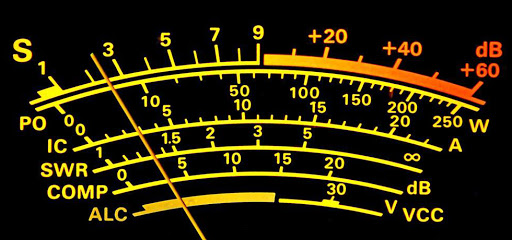
Most S-meters have an extended scale above S9, marked in decibels. The scale may be labelled +10 dB, +40 dB and so on, indicating that the signal is much stronger than S9. In that case you will hear operators say something like "you are five nine plus 20 dB".
CW operators may replace 9 with the letter N, sending the report as 5NN. (In Morse, N is a much shorter character than 9.)
599: ..... ----. ----. and 5NN: ..... -. -. are the same thing.
There is in fact a set of "cut numbers" that CW operators often use to shorten things: 0 is
replaced by T, 5 by E, and so on. The RST report 599 can be sent as ENN.
On VHF FM, signal reports are often given in terms of FM quieting. A strong FM signal is said to "quiet the receiver", because there is practically no noise in the recovered audio. As the signal strength drops, noise starts to appear in the recovered signal. At a certain signal level the noise rises sharply and the signal becomes poor. This sharp increase is called the threshold effect: that is, FM signals do not fade gradually, they suddenly "crash" into the noise. The key idea here is that you want your signal to be strong enough to stay above the noise threshold. In terms of a signal report, a strong signal can lead to a report of "full quieting". If the signal is less than full quieting, you may hear something like "90 percent quieting" or "you have about 10% noise", both describing the amount of noise in the signal. If the signal is really noisy, the report may be "50% quieting".
You will also hear the classic 59 signal report on FM, where it means "an excellent signal". The S-meters of CW/SSB transceivers, meanwhile, are often poor on FM.
Sometimes the operator at the other end is looking for a more precise and critical assessment of their signal quality. If they say something about "testing a new microphone" or "trying to solve an audio problem", that may be a hint to spend a little extra time really listening to the signal and giving additional comments on how it sounds. For most of us it is impossible actually to hear our own signal on the air, so quality feedback from other operators is very helpful.
The RST system as given on the ARRL website (http://www.arrl.org/quick-reference-operating-aids):
Readability
- Unreadable, reception impossible.
- Occasional words and letters can be made out.
- Readable, but with great difficulty (30–50%).
- Readable with practically no difficulty.
- Perfectly readable (100%).
Signal strength
- Faint signals, barely perceptible.
- Very weak signals, reception almost impossible.
- Weak signals, received with difficulty.
- Fair signals.
- Fairly good signals.
- Good signals.
- Moderately strong signals.
- Strong signals.
- Extremely strong signals.
Tone
- Extremely rough, hissing tone.
- Very rough tone.
- Rough, slightly musical tone.
- Fairly rough tone, moderately musical.
- Musically modulated tone with a ripple.
- Filtered tone, a definite trace of modulation ripple.
- Near-pure tone, a slight trace of modulation ripple.
- Near-perfect tone, a faint trace of modulation.
- Perfect tone, no trace of ripple or of any modulation.
Source: UT3USW's personal blog