Cross-band LoRa networking and REPEATER (parrot) mode
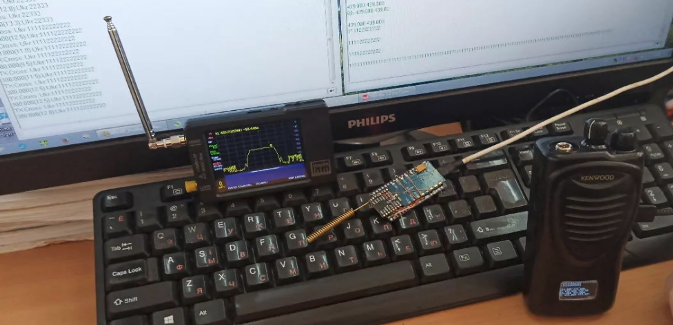
At present the Meshtastic project has no support for two SPI (or UART) LoRa modules to build a repeater or gateway for data between networks on different bands. Alternative MESH projects, however, offer this out of the box. In CrossBand mode, two-way half-duplex relaying of "any" data up to 250 bytes per packet is performed between two LoRa networks on "any" frequency, either in clear or under AES256, through the primary and secondary LoRa modules, with decryption at the other terminals.
"Any" data and frequency here means whatever the specifications of the particular LoRa transceivers and the limits of the physical channel allow. Bear in mind that channel bandwidth and spreading factor are what determine the data rate. To avoid dropped packets, therefore, the interval between packets on the faster network must be longer than the transmission time on the slower one (the one with the higher SF and/or lower BW).
The CrossBand algorithm
- On receiving any data packet, for example on EU_433 (Meshtastic) at 433.575 MHz, the packet is relayed unchanged onto the preset chosen by the user (868 MHz, say).
- On receiving any packet on the user's chosen preset, the packet is relayed unchanged onto 433.575 MHz, the EU_433 (Meshtastic) channel.
What it makes possible
-
Joining LoRa radio networks and MESH on LoRa networks (Meshtastic and others) together, both locally and over satellite links operating on different frequencies (433 and 868 MHz, for example, or even 2.4 GHz) and with different bandwidths and spreading factors. That is, bridges can be built between satellite channels and even between channels of different satellites.
-
Improved radio concealment when working on a simplex channel. The REPEATER mode of the primary and/or secondary LoRa module extends the coverage of the radio network, or acts as a parrot. In this mode a packet is received and re-transmitted on the frequencies and with the parameters set individually for the primary and the secondary LoRa module.
-
CrossBand and REPEATER modes can work either together or separately, in half duplex.
-
Support for the SX126x (SX1261, SX1262, SX1268, LLCC68), SX127x (SX1272, SX1273, SX1276, SX1277, SX1278, SX1279) and SX128x (SX1280, SX1281, SX1282) transceiver families, with the primary and secondary radio modules configurable for LoRa or FSK.
-
A shared SPI bus is used to connect the second LoRa module of the SX126x, SX127x or SX128x series. The control signals, however, need their own GPIO lines.
REPEATER mode
This mode can be enabled independently for the primary and secondary radio modules, for work on a simplex channel or on split frequencies. Besides relaying text messages it can also relay voice messages between two distant correspondents who cannot hear each other, and a chain of several such repeaters can be built for better coverage of "difficult" terrain — that is, a peer-to-peer voice MESH — in the following modes:
- Open
- AES256 encryption with a static key
- AES256 encryption with a dynamic key, where a GPS module is fitted